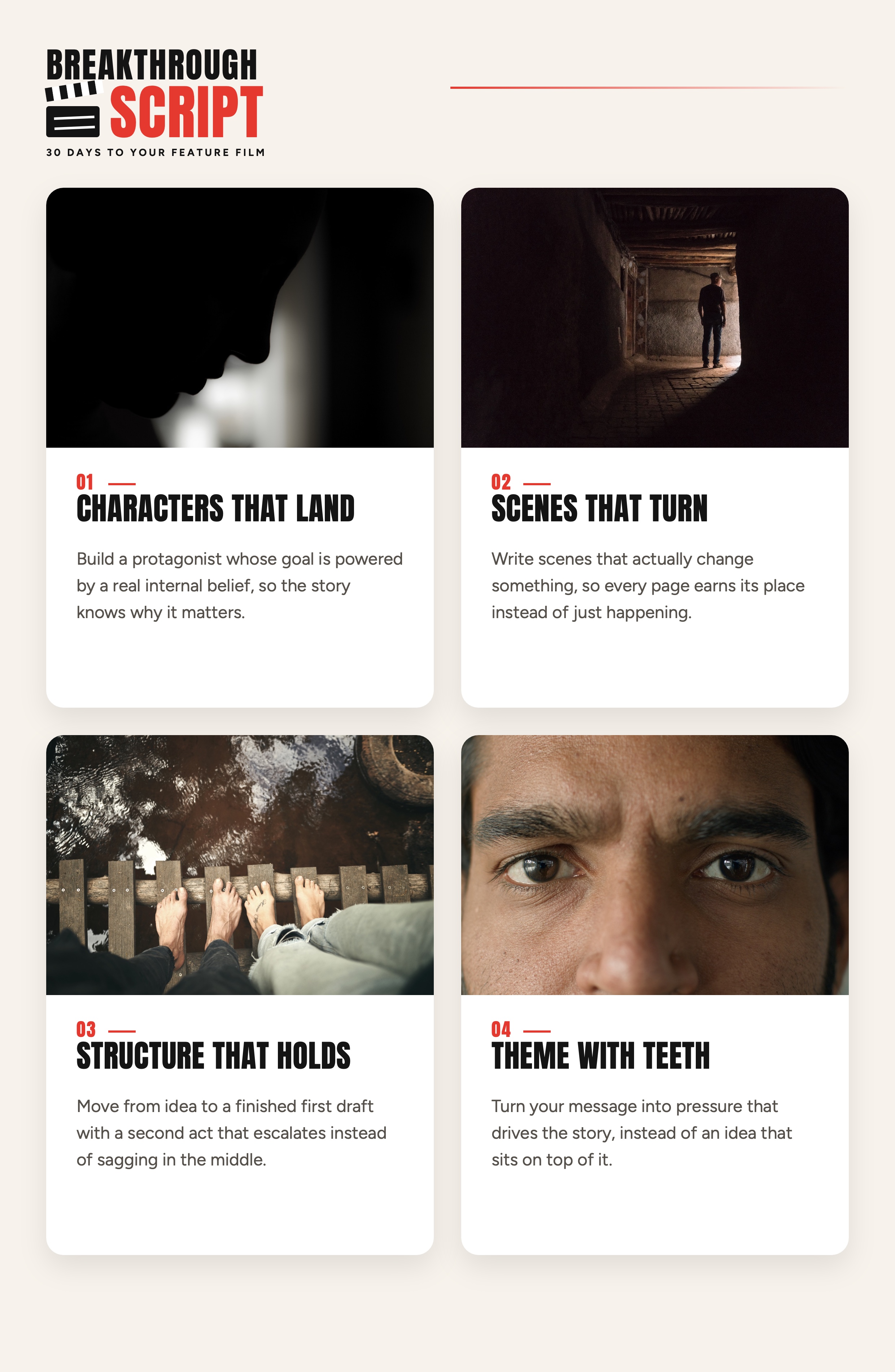
In just 30 days, Breakthrough Script gives you a repeatable writing system that replaces guesswork with a clear path from “idea” to a script that reads like a pro wrote it.
Instead of stalling out in act two, you sit down knowing exactly how to drive your story all the way to FADE OUT, with clear, connected steps that keep you moving. Writing time becomes focused, doable sessions where you see real pages stack up because you've laid the groundwork.
Your characters stop feeling “thin” and start provoking real emotional reactions, because every choice they make is tied to a clear inner journey and a sharp thematic question. Instead of “I didn’t get it” notes, people talk about moments they loved—and why it stayed with them.
Readers feel your scenes move, your dialogue snaps while carrying needed subtext, and they praise how visual a read it was. You send work out knowing it's professionally structured, polished, and - the things executives love... an "easy read"
You'll know exactly how to create a plot and structure that organically comes from your character, not added on to it.
The Belief Cycle System is present in all stories, from Legally Blonde to Moonlight to Everything Everywhere All at Once. When your protagonist's internal logic drives the external story, everything clicks into place. We give you a framework you can apply to every screenplay you write.

Never again feel lost in your script and wondering what you should to do next. Every step of the process is laid out for you, from your first idea through your final revision.
Breakthrough Script is a 30-day course with 200+ video lessons (20+ hours) that walk you through the complete screenwriting process: concept, character development, scene construction, structure, and a 20-pass revision system that helps you refine your first draft into something you’re proud of and ready to send out.

Writers need writers. The Herd is there to give feedback and encouragement, as well providing direct access to Keren and our other instructors when you have questions.
There’s something about knowing other people are at their desks at the same time you are, working through the same process. And when you watch how another writer solves the same structural problem differently than you might have, it expands what you think is possible.

What happens after FADE OUT?
Writing a great screenplay is one thing. Getting it into the world is another. Beyond the Script is a complete post-draft resource covering everything you need to put your work in front of the right people, including: loglines, synopses, one-pagers, and query letters that actually get read.
Module 2 takes you further: how to pitch verbally in a room, how the industry landscape works, what to do with contests and fellowships, how to find representation, and what it looks like to build a career writing screenplays.

Designed for those who want to explore working with AI, but not being replaced by AI, we offer an optional writing partner plugin who can work with you and help guide you through the course.
The Course Writing Partner is a custom built specifically for this course and trained on the full course methodology. Ask it to pressure-test your protagonist's false belief. Talk through a structural problem at any hour, day or night. Unlike a general-purpose AI tool, this one knows the framework you're working from and exactly how to help (without doing any of the writing for you).


I’ve worked with writers who have never written a screenplay before — who don’t know the format, the structure, or where to begin — and writers who have written one or more scripts, and are absolutely convinced they already know how story works, even when the feedback says otherwise.
And I’ve sat in both of those seats, myself, as well.
I loved movies. I had strong instincts. But I didn’t have craft. And in those early days of screenwriting my ego told me, over and over, that the critics were wrong — that I knew better. (Spoiler: I didn’t.) I became defensive when I received negative feedback, telling myself...
They don’t get it.
They’re missing what I’m trying to do.
That belief cost me years. Years that I couldn’t get back.
Here’s the hard truth I wish I could go back and give myself when I was a naïve young writer:
Falling in love with your writing is dangerous to your stories and career when you don’t understand the craft.
Screenwriting is absolutely a craft. Applying it is what allows others to fall in love with your story — and at the end of the day, that matters way more.
Watching movies and learning from what came before is important — but it isn’t osmosis. Seeing hundreds of films doesn’t teach you how to build one.
For me, everything changed when I finally let go of my ego and committed to actually learning how story functions. How character drives plot. How pressure forces choice. How structure isn’t a formula you impose, but a framework that reveals what the story demands next.
I went back to school, earned multiple degrees in creative writing for entertainment, ended up working for top producers - including Oscar-winning teams — who pushed my work hard because I was finally meeting the professional bar, and I managed to earn my way into the WGA West.
I used to prep for meetings with a pep talk, telling myself it was okay if they hated it, okay if they tore it apart...
But then suddenly it all changed. They didn’t hate my work. My scripts weren’t torn apart. Instead they used words like, ”I love this.”
Doors opened. I was asked to pitch top companies. I found myself in rooms I’d spent years imagining — with companies like Amazon — hearing responses like “We love this script,” “The door is always open,” and “We’d like you to develop this for us.” Opportunities followed — not because I’d finally “arrived,” but because my scripts were finally doing what they needed to.
But that wasn’t the end of my discovery journey when it came to understanding story craft. There was a lot more to learn...
Through more than twenty years of teaching, mentoring, and workshopping hundreds of scripts — and acting as a gatekeeper myself, with the responsibility of deciding what projects should move forward and what ones shouldn’t — I started seeing new patterns clearly.
Beginners weren’t failing because they lacked imagination. Experienced writers weren’t failing because they lacked talent.
They were stuck because no one had shown them a clear, character-driven process that could carry them from idea to finished screenplay. As I dug into existing methods, taught them, tested them with students, and watched where writers consistently broke down, I began synthesizing what actually worked. Over time, a system emerged — one that could carry any writer, at any stage, all the way through the process and toward the kind of feedback they were hoping for.
That’s what Breakthrough Script is built on.
This course is for:
- Beginners who feel like they have stories to tell but don’t know where to start
- More experienced writers who can reach Fade Out but then can’t understand why their scripts aren’t landing
- Writers who are ready — finally — to stop guessing and start building stories that work
You don’t need to be touched by the muse.
You don’t need to have read all the books and watched all the YouTube videos.
And you don’t need to write ten bad scripts before you write a good one.
You need a process that works. A clear map that you can follow. A way forward that gets you to a completed, polished draft. Every time.
If you’re willing to show up, stay open, and do the work, I know how to guide you through writing a screenplay you’re proud of — because I’ve not only walked this path myself, I’ve walked many others through it as well.
WEEK 1 — FOUNDATIONS (Days 1–7)
Build the tools you'll use for the next 30 days and beyond. Week 1 establishes your screenplay's DNA before you write a single page of script while helping you develop the skills that will get the words on the page fast by the time you reach Week 3.
- Day 1 — Why story matters; how screenplays are different from other forms of writing; screenplay format and what goes on the page; where ideas come from and how to elevate them
- Day 2 — The Brain Dump: exhaust every thought you have about your story before you start shaping it; loglines and the C.D.O.G. formula; the RISE feedback method and your Herd community; marketability
- Day 3 — Character as transformation: the function of story; The Wound and False Belief System; Thematic Truth; The Four Traits
- Day 4 — Action lines: what they actually do; the craft and rules; Show Don't Tell in practice; writing action lines for your specific character; going deeper on your protagonist
- Day 5 — Dialogue: what it does and how it works; the technicals; subtext and conflict; building distinct character voice; your character's goal, what they consciously want
- Day 6 — The antagonist: function and types; The Thematic Spectrum; developing your antagonist's traits; supporting characters and building your full cast
- Day 7 — World: every story has one; locations that build your story; the rules of your world; expressing theme through environment
WEEK 2 — STRUCTURE (Days 8–15)
Build your story from the inside out, starting with your protagonist's psychology, not a plot template. Leave Week 2 with a complete, scene-level blueprint for your screenplay.
- Day 8 — Character arc and the journey of change; Need vs. Goal; pressure and how change actually happens; structure serves character; introduction to the Belief Cycle
- Day 9 — The Belief Cycle in depth; Section 1: Ordinary World with False Belief; Section 2: Challenge to Belief. applying and tracking both sections across story examples
- Day 10 — Section 3: Testing Belief in a New Context; Section 4: The Midpoint; Belief System Shows Cracks. applying and mapping both sections
- Day 11 — Section 5: Eyes Beginning to Open; Section 6: Crisis -- The Belief System Fails Completely; anatomy of a crisis. applying and mapping both sections
- Day 12 — Section 7: Action Without Agenda; Section 8: New Belief in Action (or Refusal). Completing the full Belief Cycle map for your story
- Day 13 — What a beat is; beat sheet fundamentals; But/Therefore causality; translating the Belief Cycle into your first-pass beat sheet
- Day 14 — Subplots: what they are, how to weave them in, supporting characters as subplot engines; Interest Techniques and how to apply them to flat beats
- Day 15 — Second and third passes on the beat sheet: layering sequence, rhythm, scene-level detail, and supporting characters into a complete structural blueprint
WEEK 3 — THE VOMIT DRAFT (Days 16–23)
Write your screenplay. Not a perfect draft — a complete one. Following your beat sheet section by section it’s all about momentum over perfection. Each day includes the writing focus plus troubleshooting videos for the specific problems that come up in that section.
- Day 16 — Writing Section 1: Ordinary World with False Belief. Troubleshooting: the Placeholder Method, on-the-nose dialogue, exposition through action, when your beat sheet changes mid-draft
- Day 17 — Writing Section 2: Challenge to Belief. Troubleshooting: pacing your scenes, scene transitions, staying creative within structure
- Day 18 — Writing Section 3: Testing Belief in a New Context. Troubleshooting: tracking multiple characters, subtext layers, action line clarity, the writing vs. editing distinction
- Day 19 — Writing Section 4: The Midpoint; Belief System Shows Cracks. Troubleshooting: writing the midpoint, placeholder discipline, managing subplots, tracking belief state
- Day 20 — Writing Section 5: Eyes Beginning to Open. Troubleshooting: writing vulnerability, updating your beat sheet mid-draft, exposition overload, the temptation to revise, when the story feels broken
- Day 21 — Writing Section 6: Crisis — The Belief System Fails Completely. Troubleshooting: writing the crisis, supporting cast in the darkest moment, pacing emotional sections. Halfway celebration.
- Day 22 — Writing Section 7: Action Without Agenda. Troubleshooting: writing the transformation, climax vs. resolution, thematic payoff, the final push
- Day 23 — Writing Section 8: New Belief in Action. First Draft complete celebration. What to do with your placeholders. Draft exchange with Herd members. RISE feedback at draft one. Week 3 close and Week 4 preview.
WEEK 4 — THE 20-PASS REVISION SYSTEM (Days 24–30)
Most screenwriting education stops at the first draft. This is where this course is different. The 20-pass revision system gives each pass a specific job, so instead of reading your script vaguely hoping to "make it better," you know exactly what you're looking for each time.
Day 24 — Macro Passes
- Pass 1: Theme Integrity Check
- Pass 2: Protagonist Transformation Mapping
- Pass 3: Antagonist Architecture
- Pass 4: Supporting Character Constellation
- Pass 5: Emotional Arc Tracking
Day 25 — Structure Passes
- Pass 6: Chain Analysis (But/Therefore throughout the full draft)
- Pass 7: Tension Architecture
- Pass 8: World as Character
Day 26 — Character Depth, Part 1
- Pass 9: Wound-to-Wisdom Tracking
- Pass 10: Relationship Dynamics
Day 27 — Character Depth, Part 2
- Pass 11: Character Traits Check (Four Traits on the page)
- Pass 12: Voice Authenticity and Expression
- Pass 13: Choice Escalation
Day 28 — Dialogue
- Pass 14: Subtext
- Pass 15: Monologue Power Moments
Day 29 — Visual Storytelling
- Pass 16: Symbolic Consistency
- Pass 17: Show Don't Tell Audit
Day 30 — Final Polish
- Pass 18: Genre Expectation Balance
- Pass 19: Rhythm and Tone
- Pass 20: Final Wordsmithing
Day 30 ends with: YOU HAVE A PROFESSIONAL FIRST DRAFT — ready to share with managers, agents, producers, contests, and fellowships.
Also included throughout the course:
- The Placeholder Method — how to keep writing when you're stuck (introduced Day 2, applied throughout Week 3)
- The RISE Feedback Method — how to give and receive notes in The Herd community
- BONUS CONTENT “What Comes Next?” — query letters, verbal pitching, contests and fellowships, finding representation, and what building a screenwriting career actually looks like
You have a story idea you can't stop thinking about but when you sit down to write it, you don't know where to start. This course gives you a clear structure from the very first day.
You've started screenplays before but never finished one you hit a wall somewhere in the middle and couldn't find your way through. The 30-day pacing and vomit draft method are specifically designed to get you to FADE OUT.
You've written a draft but know it's not working you can feel it, even if you can't name what's wrong. The structure taught builds in the solutions before the worst problems occur and the 20-pass revision system teaches you to diagnose and fix it anything that needs elevation, pass by pass.
You want to understand how character drives story not plot first, not concept first. If you've ever heard "write from character" and wanted to know what that actually means in practice, the Belief Cycle System is the answer.
You're willing to commit. You've tried passive learning (reading books, watching YouTube) and know you need a real process with daily accountability and a community around you.
You want to finish something you can actually send out to managers, agents, producers, competitions, and fellowships. This course ends at professional first draft, not at “good for a first attempt.”
You want to explore AI thoughtfully, not to outsource your creativity, but to have a tool that understands your methodology and can help you think through problems at any hour. (Always optional. Always clearly labeled.)
You're looking for a shortcut. This course is 30 days of real work. If you want AI to write your screenplay for you, this isn't that. The entire course is built on the principle that you are the writer.
You already have a polished, industry-ready draft and need notes or coverage. Breakthrough Script is a writing course, not a script consultation service.
You're expecting to passively watch videos and have a script appear. The lessons require you to do the work between sessions: brain dumps, loglines, beat sheets, and speed writing your vomit draft before you dive into a 20-pass revision. The course provides the method; you provide the hours.
You're a TV writer looking for a TV-specific curriculum. Breakthrough Script is built around feature film structure. The core principles apply across formats, but the framework, the beat sheet, and revision passes are designed for features. If you want to understand feature structure as a foundation, this course is excellent groundwork. If you need TV-specific training, this course isn't built for that. Keep an eye out for our Pitch & Pilot course coming soon!
You want guaranteed representation or a produced credit. No course can promise that. This course promises you a professional first draft and the knowledge of how to get it into the right hands. What happens from there depends on many things outside a course's control.